
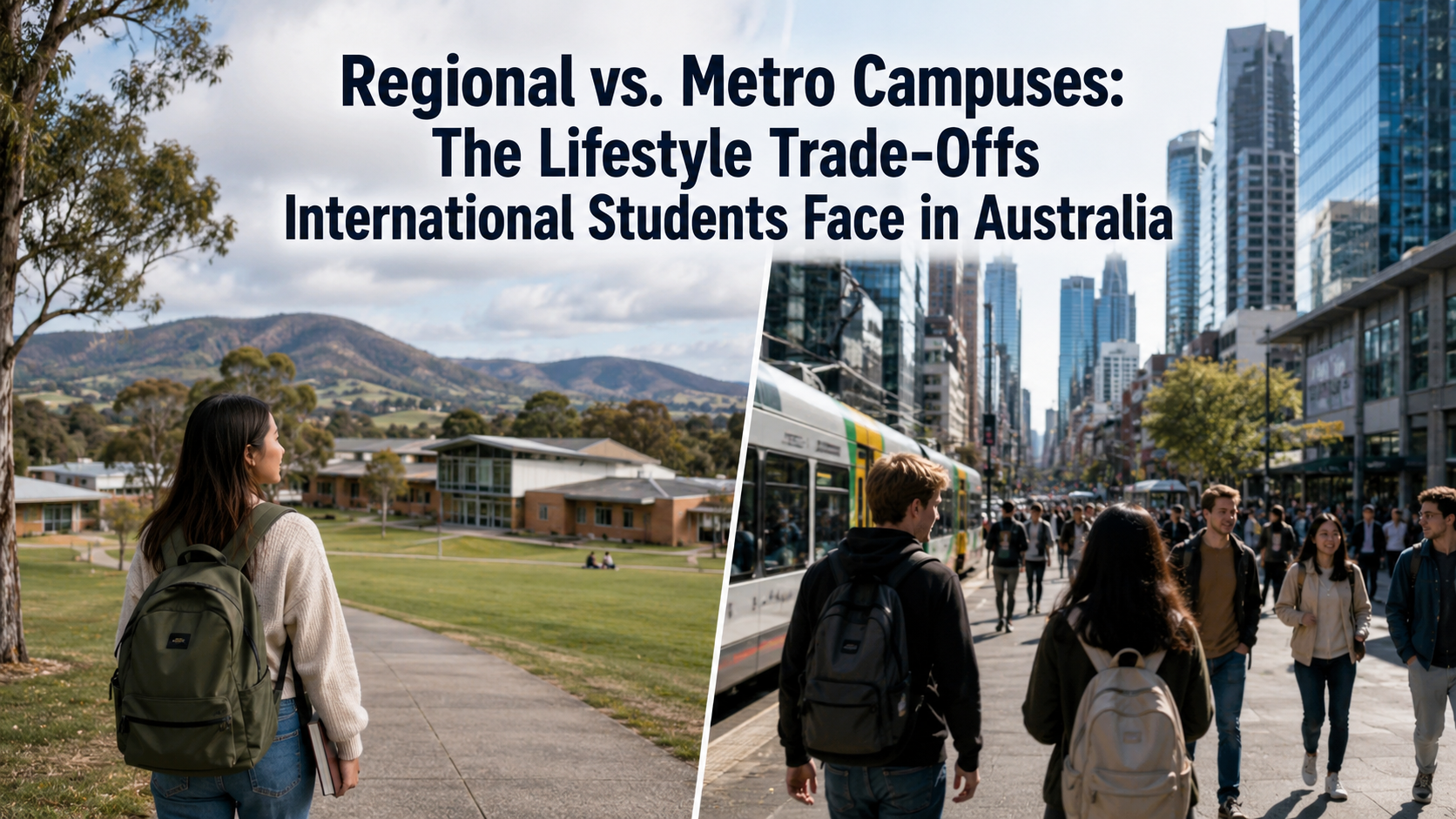
Choosing a campus in Australia is not just an academic decision. For international students, location affects rent, transport, friendships, jobs, industry access, weekend life, and even how quickly Australia starts to feel like home. Metro campuses offer scale, cultural variety, major employers, and busy social calendars. Regional campuses can offer lower living pressure, tighter communities, shorter commutes, and closer local networks. The better choice depends on your budget, course, personality, career plan, and support needs.
Australia had 551,717 international students in January 2026, with 58% coming from China, India, Nepal, Vietnam, and Bangladesh. Higher education remained a major draw, with master’s coursework and bachelor’s degrees each making up 42% of higher education study levels that month.
The real difference is daily life, not just distance
Metro campuses in Sydney, Melbourne, and Brisbane often feel like international crossroads. You can hear several languages on the tram, find food from home, join niche student clubs, attend major industry events, and meet graduates working across global companies.
Regional campuses offer a different rhythm. In places such as Wollongong, Newcastle, Geelong, Ballarat, Bendigo, Toowoomba, Launceston, Townsville, Cairns, and the Sunshine Coast, students often get a calmer setting, easier access to nature, and more visible community ties.
Australia’s regional classification also includes several larger centres, with Category 2 areas covering cities and major regional centres such as Perth, Adelaide, the Gold Coast, Sunshine Coast, Canberra, Newcastle/Lake Macquarie, Wollongong/Illawarra, Geelong, and Hobart.
Housing: metro variety vs regional breathing room
Accommodation is often the first shock. Metro cities have more student housing, more shared houses, more suburbs, and more transport links, but they also attract fierce competition. Students may need to inspect several properties, pay higher rent, or live farther from campus to stay within budget.
Regional areas are not automatically cheap, but smaller student cities often have more affordable rental accommodation, transport, and entertainment options. Groceries may not change much across the country, especially at major supermarkets, but local markets can help students find cheaper fresh produce.
Recent rental data backs up the trade-off. In March 2026, regional median rent was $612 per week, below the combined capital city median of $724. Regional vacancy rates were also slightly higher at 1.9%, compared with 1.7% in capitals, though both markets remained tight.
For a student sharing with two or three housemates, that rent gap can affect food choices, study time, and stress. A metro student may gain access to more part-time roles but spend more on rent and transport. A regional student may save on housing but need to plan harder around job availability and transport timetables.
Transport: choice vs simplicity
Metro campuses usually give students more ways to move: trains, trams, buses, bikes, rideshare, and late-night services. That helps if you work after class, live far from campus, or need to attend events across the city.
The downside is time. A one-hour commute each way can drain energy. Students who choose cheaper housing outside the inner city can spend a large part of each week travelling.
Regional campuses often give students shorter commutes. Some can walk or cycle to class. The trade-off is limited public transport after dark, fewer direct routes, and a greater need for careful planning. In some towns, buying a bike or sharing rides with classmates becomes part of student life.
Social life: big-city energy vs close community
Metro life suits students who like choice. You can join cultural groups, attend concerts, visit galleries, try new restaurants, and meet people from many backgrounds. This helps international students who want a wide social circle or who feel safer knowing their cultural community is nearby.
Regional life can feel more personal. Smaller campuses may make it easier to recognise classmates, speak with lecturers, and become known in student groups. Smaller capitals and regional study locations for shorter travel times, strong communities, arts and food scenes, nature access, and closer links with local employers.
The challenge is fit. A student who loves nightlife may feel limited in a smaller town. A student who gets overwhelmed by crowds may feel calmer outside major metro centres. Neither setting is better for everyone.
Jobs and career access: scale vs proximity
Metro cities usually offer more part-time work across retail, hospitality, tutoring, administration, events, and internships. They also host large employers, head offices, tech hubs, hospitals, finance firms, design studios, and professional meetups.
Regional cities can be strong for practical networks. Smaller local industries may be easier to approach, especially in health, education, agriculture, tourism, community services, engineering, environmental work, and regional business. In some cases, local employers know the campus well and actively look for students.
Students should not assume a location guarantees work. Australia warns that it may take time to find a job, earnings may be lower than expected, and students need savings before arriving. It also notes the student work limit of 48 hours per fortnight during study terms and semesters, with unlimited hours during study breaks.
The smart question is not “Which city has more jobs?” It is “Which location has the right kind of work near my course, timetable, and skill level?”
Academic experience: prestige is only one part
Many international students start by comparing the best universities in Australia through rankings. Rankings can help, but they rarely explain class size, local placement access, lecturer availability, housing pressure, or how supported a student feels in week five of semester.
A metro campus may suit students seeking specialist facilities, broad elective choices, large research groups, and major industry guest speakers. A regional campus may suit students who value smaller cohorts, practical learning, and closer staff-student contact.
Australia has universities, vocational institutes, schools, and English language colleges across many study locations, giving students more than one way to build an academic plan.
The strongest choice links course quality with lifestyle fit. A high-ranked university in a city that drains your budget may not serve you as well as a strong regional campus where you can study, work, rest, and take part in campus life.
Culture shock: anonymity vs belonging
Metro cities let students blend in. For some, that is comforting. You can find familiar food, religious spaces, language groups, international supermarkets, and cultural festivals. You may feel less visible as a newcomer.
Regional communities can create quicker belonging, but they may also feel exposed at first. You might be one of fewer students from your country. That can be lonely, yet it can also speed up English practice and local friendships.
Students who thrive regionally often say yes early: to orientation, volunteering, sports, casual campus events, local markets, and study groups. Students who thrive in metro settings often build smaller circles inside a large city so they do not get lost in the crowd.
Safety, wellbeing, and pace
Australia is widely chosen for its quality of life, multicultural culture, and student support services.
Still, wellbeing depends on more than national reputation. A student in a metro area may enjoy freedom but feel financial pressure. A student in a regional town may feel calmer but miss family, familiar food, or big-city entertainment.
Pace is personal. Some students need noise, ambition, and big events to stay motivated. Others need quiet evenings, open space, and a campus where people remember their name.
How to choose between regional and metro campuses
Start with your non-negotiables. If your course needs placements in a specialist hospital, finance district, media hub, or research lab, location may be clear. If your budget is tight, housing and transport should move near the top of your decision.
Next, map your weekly life. Where will you live? How long is the commute? Can you get home safely after work? Are part-time jobs close by? Is there food you can eat comfortably? Can you access medical care, faith spaces, sport, and social support?
Then think about your temperament. Metro study rewards students who enjoy scale and can manage distraction. Regional study rewards students who value routine, community, and a slower pace.
Final take: pick the place that helps you stay consistent
The metro-versus-regional choice is not a contest between “better” and “worse”. It is a trade-off between access, cost, pace, community, and opportunity.
Metro campuses can give international students global energy, wider work options, and large professional networks. Regional campuses can give students breathing room, closer relationships, shorter commutes, and a stronger local feel.
The best decision is the one that helps you attend class, manage money, build friendships, stay healthy, and grow into your career. For international students planning to study in Australia, campus location is not just a pin on a map. It is the setting for everyday success.