
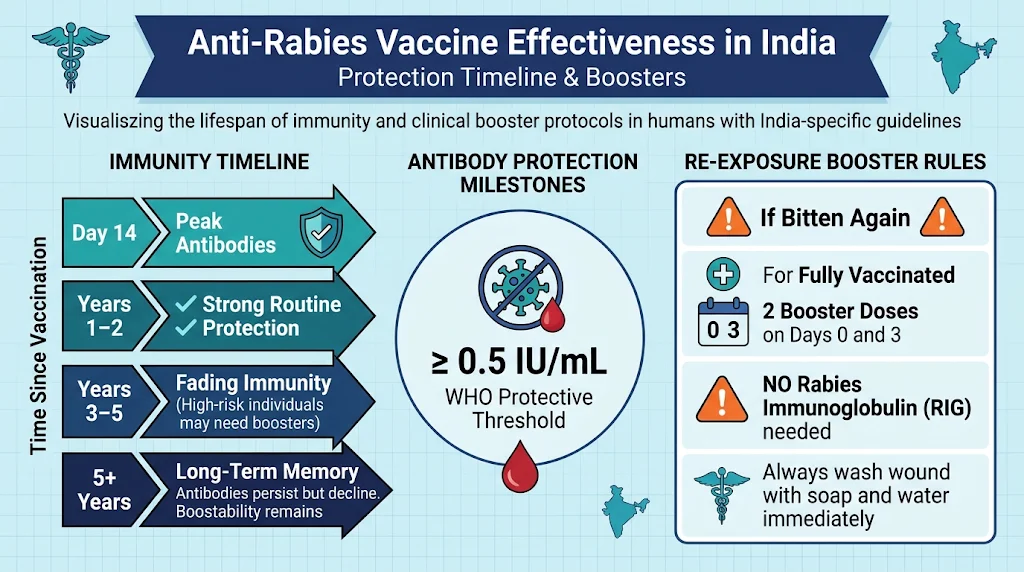
People who have completed an anti-rabies vaccination course often wonder how long the protection will last. Does it remain effective for five years, ten years or even longer? This question becomes particularly important when someone experiences another dog bite several years after receiving the vaccine.
The answer to how long anti rabies vaccine is effective in humans india depends on the person’s vaccination history, immune response and exposure risk. Research has demonstrated that immune memory can remain active even 10–24 years after pre-exposure vaccination. However, this does not mean every person has guaranteed protection throughout that period.
There is no fixed expiry date for rabies vaccination. A person who has received the complete course should not automatically repeat it after five or ten years. However, a fresh animal bite requires immediate medical assessment, even when the person was vaccinated in the past.
How Long Anti Rabies Vaccine Is Effective in Humans India?
Modern anti-rabies vaccines help the body develop antibodies and immune memory against the rabies virus. Although antibody levels may decrease over time, memory cells can help the immune system respond quickly to future exposure.
A study published in the Journal of Infectious Diseases examined 28 people vaccinated 10–24 years earlier. All developed an adequate antibody response within seven days of receiving a booster dose.
This suggests that anti-rabies vaccine protection can last for many years, but it does not guarantee lifelong protection. There is no fixed five-year, ten-year or fifteen-year expiry period. The need for booster doses depends on vaccination history and any new exposure.
Anti Rabies Vaccine Effectiveness: Important Time Periods
The following table explains the time periods associated with rabies vaccination and long-term immune memory.
| Time period | What it means |
| 5 years | Antibodies may remain detectable in some vaccinated individuals. |
| 10 years | Research has demonstrated that immune memory can still respond to a booster. |
| 10–24 years | A study found an adequate booster response in all 28 previously vaccinated participants. |
| After a new exposure | Previously fully vaccinated people generally receive two booster doses on days 0 and 3 under Indian guidance. |
The 10–24-year period refers to documented immune memory, not a guarantee of complete protection. It is also important to distinguish the time since vaccination from the treatment required after a fresh animal bite.
What Happens to the Body After Rabies Vaccination?
After vaccination, the immune system produces antibodies that recognise the rabies virus. It also develops memory cells that help the body respond when it encounters the virus again. The amount of circulating antibodies can decrease with time. This is a normal part of the immune response and does not automatically mean that vaccination has become ineffective.
However, the response can differ between individuals. Age, general health and immune-system conditions can affect how well a person responds to vaccination.
People with weakened immunity may require additional medical attention. Conditions such as HIV infection, cancer treatment and medicines that suppress immune activity can affect vaccine responses. Doctors may recommend antibody testing or a different vaccination plan in these situations.
A person cannot determine their level of protection by counting the years since their last injection. Medical advice is necessary after every possible rabies exposure.
What Do Indian Guidelines Say About Repeat Rabies Exposure?
India’s National Guidelines for Rabies Prophylaxis provide a separate treatment approach for people who have already completed a recognised pre-exposure or post-exposure vaccination course.
According to the National Rabies Control Programme’s guidance, a previously fully vaccinated person who experiences another Category II or Category III exposure generally needs two booster doses.
| Dose | When it is given |
| First booster | Day 0 |
| Second booster | Day 3 |
The doses can be administered through the approved intradermal or intramuscular route. Rabies immunoglobulin (RIG) is generally not required for a previously fully vaccinated person.
This recommendation applies when the person can document a complete previous vaccination course using a modern rabies vaccine. Someone who received only one or two injections without completing the required schedule may need a different treatment plan.
If you experience another bite, carry your old vaccination record to the hospital. The doctor will check the previous doses, assess the new exposure and decide the appropriate treatment.

Anti Rabies Vaccine Schedule in India
The first-time post-exposure vaccination schedule is different from the booster schedule for previously vaccinated people.
India’s National Guidelines for Rabies Prophylaxis describe the following schedules for people receiving post-exposure vaccination for the first time:
| Route | Vaccination days | Number of visits |
| Intradermal (ID) | 0, 3, 7 and 28 | 4 |
| Intramuscular (IM) | 0, 3, 7, 14 and 28 | 5 |
For the intradermal method, 0.1 ml is administered at two sites during each scheduled visit. For the intramuscular method, one full vaccine dose is given at each visit.
Previously vaccinated people generally follow the shorter two-dose schedule on days 0 and 3 after a new exposure.
The route and schedule should be selected by a healthcare professional. People with weakened immunity may require a different approach, including a full intramuscular course and additional medical monitoring.
Difference Between Pre-Exposure and Post-Exposure Rabies Vaccination
Rabies vaccination is given either before or after a possible exposure. These two approaches have different purposes.
Pre-exposure prophylaxis (PrEP) is given to people who have a higher risk of coming into contact with the rabies virus. This includes certain veterinarians, animal handlers, laboratory workers and wildlife professionals.
India’s 2019 guidelines describe a traditional three-dose PrEP schedule on days 0, 7 and either day 21 or 28. The exact schedule should be confirmed with the vaccination centre because recommendations and approved protocols can change.
Post-exposure prophylaxis (PEP) is given after a possible exposure, such as a bite or scratch from an animal. It includes immediate wound washing and rabies vaccination. Rabies immunoglobulin may also be needed for eligible Category III exposures in people who have not been vaccinated previously.
Even after receiving PrEP, a person must seek medical care following a bite. Previous vaccination changes the treatment required, but it does not remove the need for wound care and assessment.
When Is Rabies Immunoglobulin Required?
Rabies immunoglobulin provides ready-made antibodies and is generally recommended for previously unvaccinated people with Category III exposure.
Category III exposure includes:
- Single or multiple bites that penetrate the skin.
- Scratches that break the skin.
- Saliva from an animal coming into contact with broken skin.
- Saliva entering the eyes, mouth or another mucous membrane.
For a person with documented complete previous PrEP or PEP, RIG is generally not required during standard repeat-exposure treatment. The person usually receives two booster doses on days 0 and 3.
There are special circumstances that require individual assessment. For example, doctors may consider additional measures if direct nerve exposure is suspected. People with weakened immunity also need a separate treatment plan.
What to Do After a Dog Bite If You Were Vaccinated Earlier
A previous vaccination record should never be a reason to ignore a new bite. Immediate wound care and medical assessment remain important.
Follow these steps after a possible exposure:
- Wash the wound: Clean the affected area with soap and running water for at least 15 minutes.
- Apply an antiseptic: After washing, use an appropriate antiseptic such as povidone-iodine if available.
- Visit a hospital: Get the wound assessed as soon as possible, even if it looks minor.
- Carry your vaccination record: Show the doctor the dates and details of your earlier injections.
- Complete the prescribed treatment: Follow the recommended booster schedule or full course.
Avoid applying turmeric, chilli powder, oil, lime or other home remedies to the wound. Do not wait for symptoms before seeking medical attention. Rabies is almost always fatal once clinical symptoms develop, but prompt and appropriate post-exposure treatment can prevent the disease.
Do You Need a Rabies Antibody Test After Vaccination?
A rabies antibody test is not necessary for every healthy person who has completed the recommended vaccination course. Testing is mainly considered for selected groups, including people with continued occupational exposure and those with weakened immune systems.
The commonly used reference level for rabies virus-neutralising antibodies is 0.5 IU/ml. Certain professionals who have regular exposure to the virus may need periodic antibody monitoring. A booster may be recommended if their antibody level falls below the required reference level.
Testing can help doctors assess the immune response, but it should never delay treatment after a fresh animal bite. Anyone with a possible rabies exposure should seek medical care immediately.
Wrapping Up
The answer to how long anti rabies vaccine is effective in humans india is not a fixed number of years. Research has demonstrated that immune memory can remain responsive even 10–24 years after pre-exposure vaccination. However, this should not be treated as a guarantee of lifelong protection.
For a fresh bite, previously fully vaccinated people generally receive two booster doses on days 0 and 3 under Indian guidance. People without proof of a complete earlier course may need the full post-exposure vaccination schedule.
Keep your vaccination records safe, wash any bite or scratch with soap and running water for at least 15 minutes, and seek medical attention promptly. Never rely only on the number of years since your last injection.
Frequently Asked Questions
Q1. How long anti rabies vaccine is effective in humans India?
The anti-rabies vaccine can provide immune memory for many years, but there is no fixed expiry period. Its effectiveness and the need for booster doses depend on previous vaccination history and any new exposure.
Q2. Do I need a rabies vaccine again after 10 years?
Not necessarily. If you have a new animal bite after 10 years, consult a doctor. Your previous vaccination records will help determine whether you need booster doses or a fresh vaccination course.
Q3. Can I get rabies after completing the full vaccination course?
A complete and correctly administered rabies vaccination course provides strong protection. However, no vaccine offers a reason to ignore a new bite or scratch. Seek medical attention promptly after any possible exposure.
Q4. How many booster doses are needed after another dog bite?
Under India’s national guidelines, a previously vaccinated person with proof of a complete course generally receives two booster doses on days 0 and 3 if re-exposure occurs after three months. For re-exposure within three months, wound washing alone is generally recommended.
Q5. Is an anti-rabies vaccine effective for a lifetime?
The vaccine can create long-lasting immune memory, but lifelong protection cannot be guaranteed. The need for booster doses depends on previous vaccination, exposure history and medical advice.