
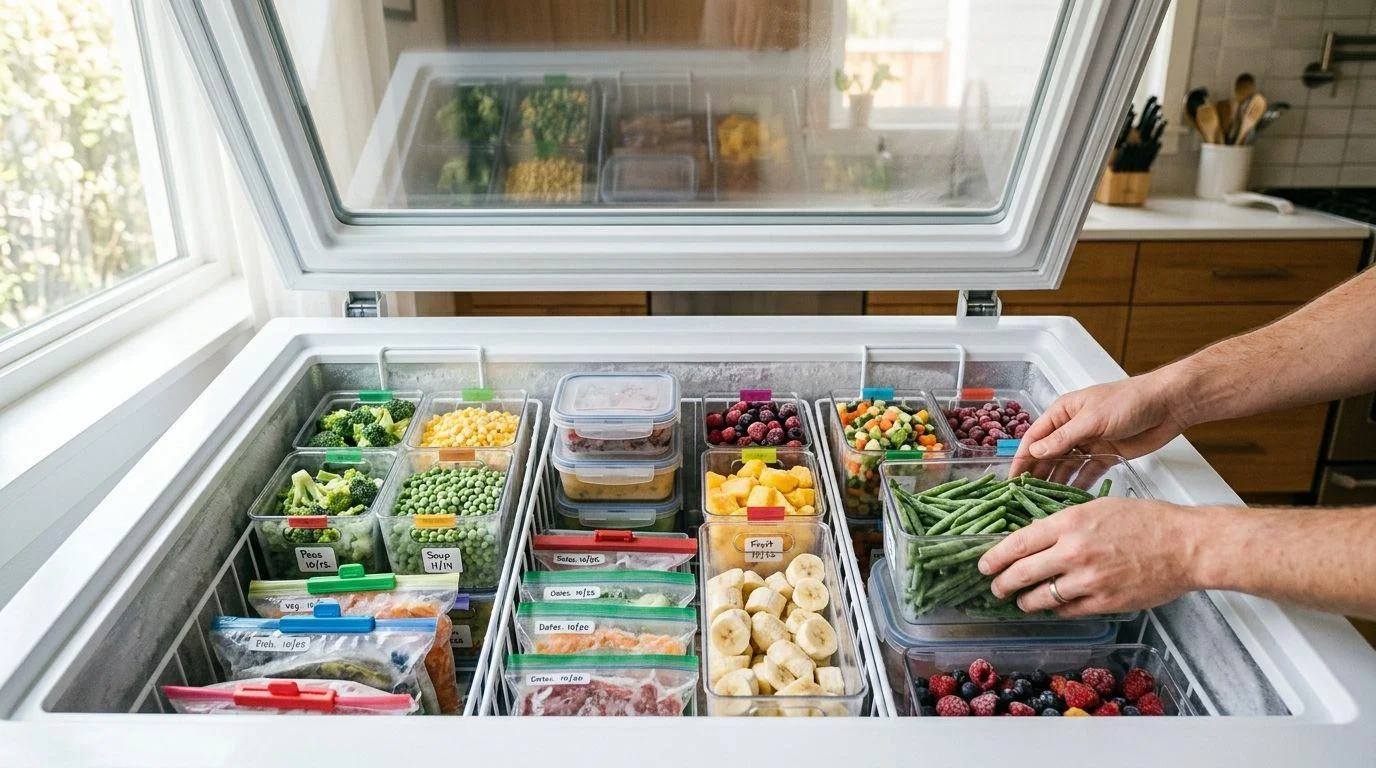
A freezer is often treated as a place to hide food rather than a tool for keeping it nutritious. Yet the way frozen items are arranged, labeled, and rotated has a direct effect on how much nutritional value ends up on a plate versus in the trash. Thoughtful freezer organization tips are less about tidiness for its own sake and more about creating a system where nothing gets lost behind a bag of ice or forgotten at the back of a drawer. When food is visible, dated, and grouped sensibly, it gets used while it is still fresh and nutrient-rich, rather than discarded months later in a questionable state.
This article looks at the connection between freezer habits and household wellness from a practical, natural-health angle: how freezing affects nutrients at a biological level, which everyday habits protect freshness, and how the design of a freezer itself can either support or undermine those habits.
TL;DR — Key Takeaways
- Poor freezer organization leads to forgotten food, which is one of the most common causes of household waste and lost nutrition.
- Freezing slows the biological and chemical processes that break down vitamins, making it gentler on nutrients than prolonged refrigeration.
- Labeling, rotating stock, and portioning food before freezing are simple freezer organization tips that keep meals fresher for longer.
- Storage that lets you see what is inside, such as clear drawers, makes it easier to use food before quality declines.
- A short weekly check of freezer contents does more for freshness than any single storage gadget.
Why Freezer Organization Matters for Nutrition and Waste
The freezer is meant to be a pause button for food, but disorganization turns that pause into permanent storage. When items are stacked without labels or logic, older packages sink to the bottom or get buried behind newer purchases. Months later, they resurface unrecognizable, freezer-burned, or simply forgotten, and the natural response is to throw them out.
That pattern matters for more than convenience. Every discarded item represents nutrients and money that never made it to a meal. A bag of vegetables frozen at peak ripeness carries real nutritional value, but only if it is eaten before quality declines. Proper organization reduces the likelihood of forgotten, wasted food by keeping stock visible and accessible, which means the vitamins and minerals locked into that food actually get consumed rather than binned.
There is also a psychological angle worth considering. A cluttered, disorganized freezer discourages cooking from scratch, because finding ingredients feels like a chore. People default to convenience foods or takeout instead, which can shift a household away from the whole, natural ingredients they intended to rely on. An organized freezer, by contrast, makes it easier to see exactly what is on hand, which supports more intentional, nutrient-conscious meal planning rather than last-minute substitutions.
The Science of Freezing: What Happens to Nutrients
Freezing works by halting the biological activity that causes food to spoil. Bacteria and mold need moisture and warmth to multiply, and once temperatures drop low enough, that growth stops almost entirely. This is different from refrigeration, which only slows microbial activity without stopping it, meaning refrigerated food continues to degrade, just more slowly than food left at room temperature.
Enzymes present naturally in fruits and vegetables also play a role in nutrient loss. These enzymes keep working even after harvest, gradually breaking down cell structures and, with them, certain vitamins. Freezing slows this enzymatic activity considerably, which is one reason frozen produce is generally thought to hold onto more of its original nutrient content than produce that spends extended time in refrigerated storage. Vitamin C, in particular, is sensitive to time, light, and oxygen exposure, and it tends to be more stable under frozen conditions than under ordinary refrigeration.
This does not mean freezing preserves every nutrient perfectly or indefinitely. Some vitamins are more heat- and processing-sensitive than others, and quality still declines gradually during long-term frozen storage due to slow oxidation and moisture loss, often visible as freezer burn. The broader point is one of comparison rather than perfection: freezing can slow nutrient degradation compared to prolonged refrigeration, which makes it a useful strategy for anyone trying to stretch the shelf life of fresh produce, meats, or home-cooked meals without sacrificing much nutritional value.
Smart Storage Habits That Preserve Freshness
Good freezer habits are less about equipment and more about a handful of consistent routines. The first is labeling, ideally including both the contents and the date it was frozen. Without a date, even a well-organized freezer becomes a guessing game, and guessing usually ends with food being either thrown out too early or kept too long.
Closely related is the “first in, first out” principle borrowed from commercial kitchens. New items get placed behind or below older ones, so the oldest stock is always the first one grabbed. This single habit prevents the common scenario where a fresh bag of bread sits on top while an older, better-suited-for-immediate-use loaf freezer-burns underneath, unused and eventually wasted.
Portioning food before freezing is another habit with real nutritional payoff. A large block of soup or a whole tray of casserole, frozen as one unit, forces a choice: thaw the entire thing or none of it. Repeated thawing and refreezing, even partial, accelerates texture breakdown and nutrient loss, since each freeze-thaw cycle ruptures more cell walls and exposes more of the food to oxygen. Freezing in individual or meal-sized portions avoids that cycle entirely, since only what is needed gets thawed at a time. A simple way to visualize these habits together:
- Label every item with contents and freeze date before it goes in.
- Place new purchases behind existing stock rather than in front.
- Freeze in portions sized for a single meal rather than one large block.
None of these habits require special tools, only a bit of consistency, but together they meaningfully reduce both spoilage and the nutrient loss that comes from repeated temperature changes.
How Kitchen Design Supports Better Food Habits
Habits are easier to maintain when the environment makes them convenient, and freezer design plays a bigger role in this than many people expect. A built-in freezer where every item is stacked in an opaque bin, three layers deep, actively works against labeling and rotation habits, because seeing what is inside requires digging. Drawers with transparent fronts solve this at a structural level: contents are visible at a glance, so older packages are not accidentally buried and forgotten behind newer ones.
This kind of visibility directly supports the FIFO habit already discussed. Clear visibility of stored items helps people use food before it spoils, simply because the reminder is passive rather than something that has to be actively recalled. Instead of trying to remember what is at the back of a drawer, a quick glance shows exactly what needs to be used soon. For households trying to eat more intentionally and waste less, this small design difference can outweigh a much more disciplined labeling system in a poorly designed unit.
Smooth-running telescopic rails contribute a similar benefit from a different angle. When a drawer glides open fully and easily under load, reorganizing it takes seconds rather than becoming a wrestling match with stuck trays or items falling out of reach. That ease makes it far more likely that a person will actually do a quick freshness check every so often, rather than avoiding the drawer because it is difficult to pull open or awkward to search through. Small frictions like a jammed rail or a bin that has to be lifted out to see the bottom are often enough to make someone skip a check they would otherwise do, so removing that friction has a real, if understated, effect on how consistently good habits actually get followed.
Simple Steps to a Healthier Freezer Routine
Turning these ideas into practice does not require an overhaul, just a repeatable weekly rhythm. Setting aside a few minutes once a week to scan freezer contents, check dates, and move older items forward keeps the FIFO system functioning instead of quietly breaking down over time. This short routine catches problems while they are still small, before a forgotten package becomes an inevitable discard.
Grouping food by type and date also simplifies meal planning considerably. Keeping proteins in one section, vegetables in another, and ready-made meals in a third means a weekly menu can be built around what is already on hand rather than defaulting to a fresh grocery run every time. This approach naturally prioritizes older stock, since it becomes visible and top-of-mind during planning rather than an afterthought.
Over weeks and months, these small habits compound. A household that checks its freezer weekly, labels consistently, and portions food thoughtfully will waste noticeably less than one relying on memory alone, and the food it does eat will tend to reflect the nutrient value it had going into the freezer, not a diminished version of it. None of this depends on any single product or gadget; it depends on a routine that fits into how a kitchen is actually used, week after week, without becoming another chore to avoid.