
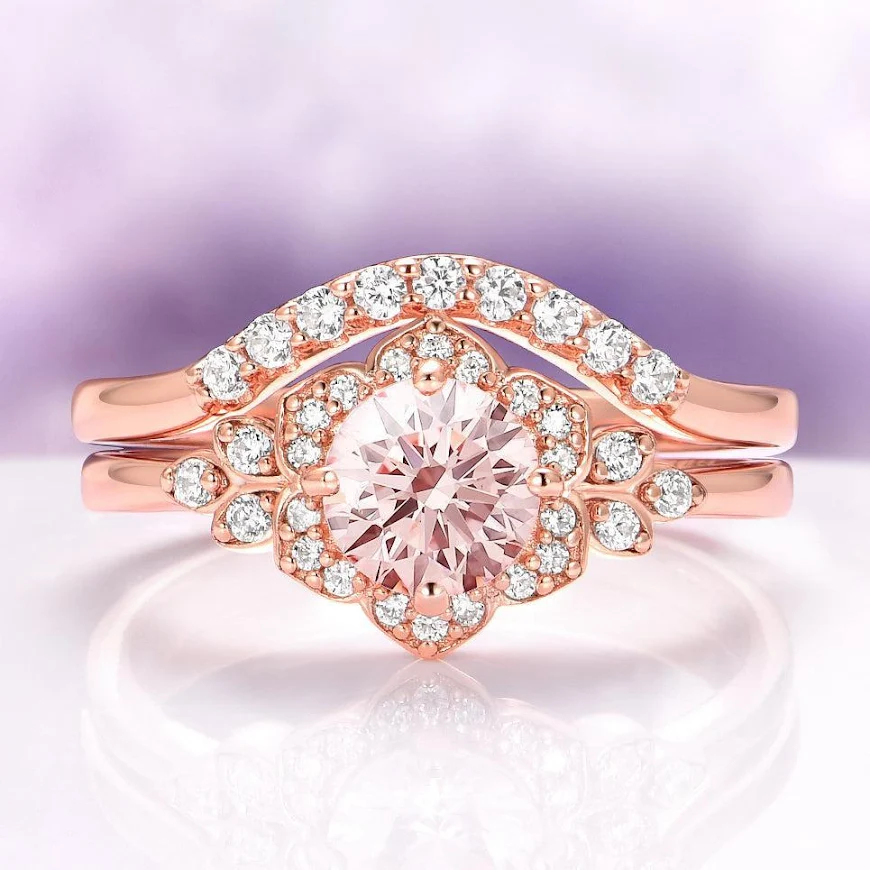
Morganite arrived in the bridal world with a color that most gemstones cannot offer: a gentle peach-pink that reads as soft rather than saturated. Choosing a metal for that stone is not a small detail. The band frames the gem, sets the temperature of the whole piece, and quietly decides whether the ring looks warm and romantic or cool and modern. Rose gold has become the metal most people reach for first, and there is a real visual logic behind that instinct. This guide walks through why the pairing works, when another metal might serve the design better, and how to keep the finished look coherent from the center stone to the rest of the bridal set.
How rose gold echoes morganite’s peach undertone
The heart of the pairing is color agreement. Morganite sits in the warm half of the color wheel, leaning toward peach, apricot, and the faintest blush. Rose gold, thanks to its copper content, carries a similar warmth in the metal itself. When you place the two side by side, the band does not fight the stone or pull it in a different direction. Instead the metal picks up the gem’s undertone and repeats it, so the eye reads one continuous warm story rather than two separate elements. That echo is why a morganite center can look slightly more pink and slightly more alive in a rose setting than it does loose or against a cooler backdrop. If you are weighing this choice as part of a larger design decision, it helps to understand building a custom engagement ring step by step so the metal, the stone, and the setting are considered together rather than one at a time.
The soft monochrome look
Because rose gold and morganite share a family of undertones, the pairing produces what designers often call a monochrome or tonal effect. The colors are close enough that the ring feels harmonized, but different enough that the stone still stands apart from the band. This is a flattering result for an engagement ring. A tonal ring tends to look gentle and cohesive on the hand, and it photographs with a soft, romantic quality that many couples want for the moment they announce. The effect also reads as understated luxury rather than high contrast drama, which suits people who prefer their jewelry to whisper. If your taste runs toward the delicate and the timeless, the soft monochrome of rose gold and morganite is often the most natural expression of it.
Rose gold and morganite settle into one warm, soft tone.
When white metals give contrast instead
Rose gold is not the only path, and sometimes contrast is exactly the point. A white metal such as white gold or platinum sits on the cool side of the spectrum, so it does the opposite of what rose gold does. Rather than blending into the stone, it frames the peach with a bright, neutral border that makes the color stand out by comparison. This can be a smart choice for someone who wants the morganite to look distinctly pink, since a cool surround exaggerates a warm center. White metals also lend a crisper, more contemporary feeling, and they coordinate easily with the cooler diamonds many people already own. If your aim is a clean, high-clarity look where the stone is the clear star, a white setting deserves serious consideration.
Yellow gold as a warmer alternative
Between the blush of rose and the coolness of white sits yellow gold, and it plays a different role again. Yellow is warm like rose gold, so it keeps the ring in the same friendly temperature, but its warmth reads as golden and sunny rather than pink. Against morganite, yellow gold creates a vintage, slightly bohemian mood that feels collected rather than matched. The peach of the stone and the honey of the metal sit near each other on the wheel without mirroring one another, which gives the ring a layered, lived-in character. For couples drawn to antique-inspired or heirloom styling, yellow gold can be the most expressive of the three warm-and-cool options.
Matching the band to the setting
The metal decision does not stop at the center stone. The setting style and the band profile both interact with the metal in ways worth planning. A few things to weigh:
- A solitaire lets the metal read clearly, so the rose gold warmth is on full display around the stone.
- A halo of small accent stones adds sparkle and can brighten a warm setting, softening the tonal effect if you want a little more light.
- A pave or accented band introduces tiny highlights along the finger, which can either reinforce the warm story or break it up, depending on the accent stones chosen.
- A plain or gently tapered band keeps the focus on the color agreement between metal and morganite.
Keeping the band and the setting in the same metal is the simplest route to a unified look, and it is why a rose gold morganite engagement ring so often appears as a coordinated whole rather than a stone dropped into an unrelated mount. When the metal is consistent from prong to shank, the eye travels smoothly across the piece.
Coordinating a warm-toned bridal look
An engagement ring rarely lives alone for long. Most people eventually pair it with a wedding band, and many like their other jewelry to agree with it. Rose gold gives you a clear organizing principle: warmth. A matching or complementary warm-toned wedding band will nest against a rose setting without any visual clash, and warm-toned earrings or a pendant will echo the same story across an outfit. The peach of morganite is forgiving and works with a wide range of skin tones, but it looks especially at home alongside blush, champagne, ivory, and other soft, warm palettes. Thinking about the ring as the anchor of a coordinated look, rather than an isolated object, tends to produce a more polished result on the day it matters most.
The takeaway
Rose gold suits a morganite engagement ring because the two speak the same warm language. The metal echoes the stone’s peach undertone, produces a soft tonal look that photographs beautifully, and gives you a natural anchor for a coordinated bridal wardrobe. White metals remain a strong choice when you want contrast and crispness, and yellow gold offers a golden, vintage warmth for those drawn to it. There is no single correct answer, only the mood you want your ring to carry. If that mood is gentle, romantic, and quietly warm, rose gold and morganite are one of the most natural pairings in modern bridal jewelry.